
In 2023, following the launch of ChatGPT, enterprises rushed to deploy AI with massive expectations and little architectural clarity. Now, the "Boss of Bots"—Daniel Dines, founder and CEO of UiPath—has published a landmark 168-page book, The Work That Remains: Human Judgment, AI, and the Architecture of the Next Enterprise, written in collaboration with Claude and ChatGPT.
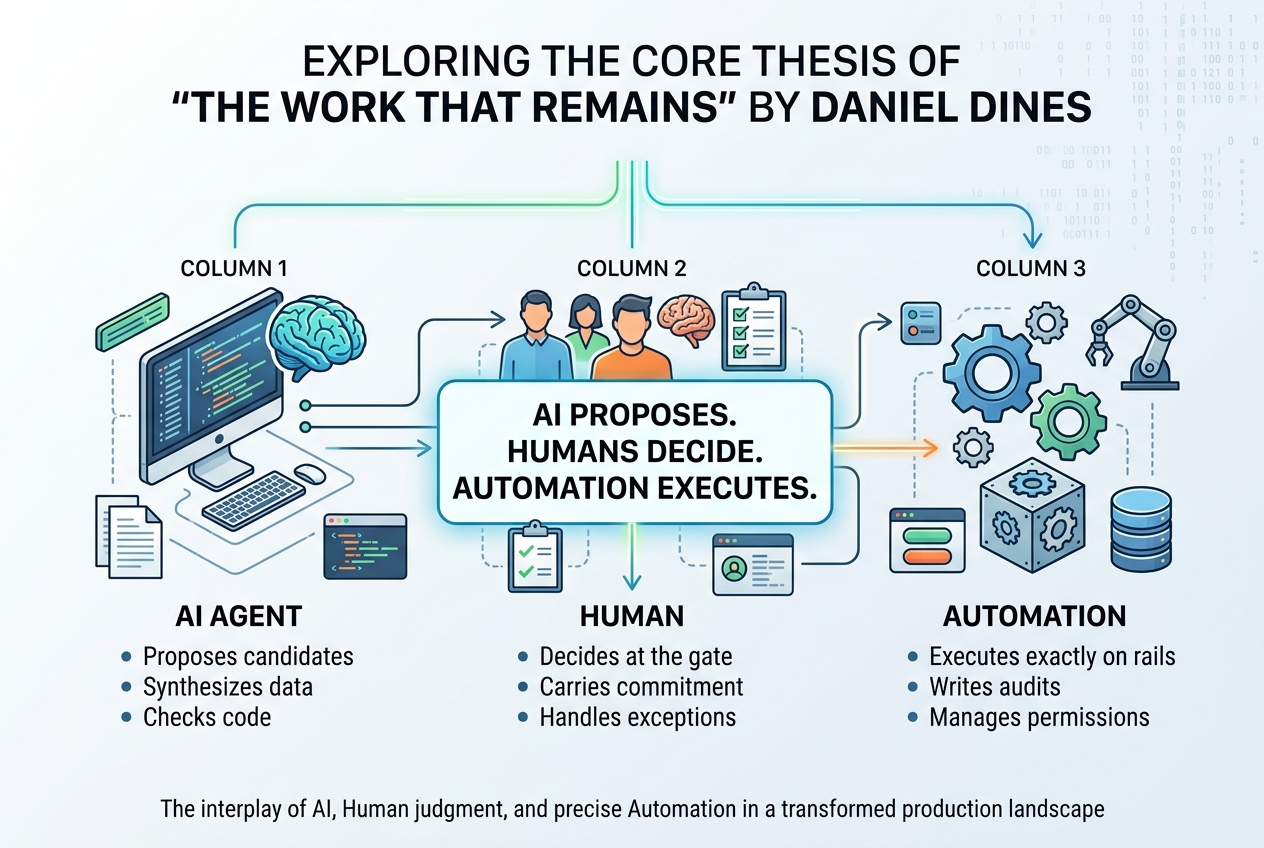
Dines delivers a sobering, highly practical framework for engineering the AI-native enterprise. He argues that the future of work is not general agents running loose in legacy companies, but rather a structured operating model where AI proposes, humans decide, and automation executes.
📕 Download the Complete 168-Page E-Book
You can download the full, print-ready PDF edition of Daniel Dines' new book directly from RPAVault.
Simply enter your details in the popup form to receive your direct download immediately.
Chapter 1: The Core Thesis
Dines' core argument divides the enterprise workflow into three distinct actors:
- The AI Agent (The Proposer): Brings speed, scale, and synthesis. It reads contexts, gathers evidence, drafts solutions, and proposes candidate decisions.
- The Human (The Decider): Brings judgment and accountability. Humans own the decisions ("the calls") where consequence, trust, and commitment are required.
- Deterministic Automation (The Executor): Brings exactness. Automated systems execute what must be precise: payments, databases, API transitions, audit trails, and state changes.
       ┌───────────┐          ┌──────────┐          ┌──────────────┐
       │ AI AGENT  ├─────────►│  HUMAN   ├─────────►│  AUTOMATION  │
       │ (Propose) │          │ (Decide) │          │  (Execute)   │
       └───────────┘          └──────────┘          └──────────────┘
The fundamental error executives make is trying to drop general-purpose AI models into a company and expecting them to learn on the job like a human hire. Dines explains that this ignores the four structural limits inherent to probabilistic models.
Chapter 2: The Four Structural Limits of AI
To build safe systems, you must understand what AI models cannot carry internally.
Limit 1: AI Does Not Learn on the Job
A human operator learns from everything: tone, hallway whispers, unwritten rules, and the memory of past mistakes. They convert being there into knowing. AI does not learn continuously in production; it is static, searching only what was explicitly written down and sent in its prompt context. Because most of what runs a business is never documented, the agent remains a "bright stranger" guessing at your rules.
Limit 2: No Self that Persists, Originates, and Individuates
AI has no identity. Using Harry Frankfurt’s philosophical vocabulary, the model is a wanton: it acts on whatever prompt or parameter is currently strongest, but cannot take a second-order stance (i.e. "this is the kind of system I refuse to be"). Because it has no career, no reputation, and no relationship to protect, it cannot carry commitment.
Limit 3: Actions Have Consequences
In language models, errors are cheap—a wrong word in a draft can be deleted. But in the enterprise, actions are state changes (e.g. initiating a wire transfer or denying a health claim). You cannot "cross out" an action once it is committed. AI lacks a built-in "consequence sensor" (doubt or fear) to pause when the stakes rise.
Limit 4: Good Enough is Not Good
AI is probabilistic; it predicts what the next word should look like based on training averages. In domains like math, tax calculation, or payment ledgers, "mostly right" is a failure. As enterprise tasks compose, errors compound exponentially. A pipeline with 100 steps, each 99.1% accurate, will fail 60% of the time. You must use deterministic rules engines to guarantee correctness.
Chapter 3: The Operating Model: The Map and the Rails
To govern AI, the enterprise must build a structured environment around the model. Dines describes this as The Map and the Rails.
                              THE MAP
              (Rules, Context, Authority, Exceptions)
                                 │
                         [The Action Gate]
                                 │
                             THE RAILS
               (Deterministic Code, APIs, Rollbacks)
                                 ▼
                         Systems of Record
- The Map: The versioned, readable description of the business. It outlines what words mean, what rules apply, who owns what, and how exceptions are handled. If the agent must guess your rules by stitching together raw database calls, you have exposed your systems, not described your work.
- The Rails: The execution machinery. The rails ensure that once a decision is approved, it runs exactly the same way every single time, with auditable logs, permissions, and rollbacks.
The model’s actual role is not to execute actions on its own, but to act as a designer at design-time—helping to map exceptions and build the deterministic rails that run the work thereafter.
Chapter 4: The Four Stages of Handover
The transition to an AI-native enterprise follows a structured ladder of authority, where the human's role narrows as the model proves its reliability:
- Stage 1: Person Orchestrates: The human coordinates the work, using AI as a basic chat assistant layered on unchanged systems.
- Stage 2: Person Supervises (Attended): The human gives the agent a task with clear constraints and stays at the keyboard to watch, redirect, and correct.
- Stage 3: Person Reviews (Unattended): The agent runs independently in the background, preparing a complete proposal with evidence. The human sits at the action boundary gate to inspect and validate.
- Stage 4: Person Handles Exceptions (Audit): Routine cases run automatically on the rails. The human's role concentrates on policy-setting, audit reviews, and resolving anomalies.
Dines warns that companies trying to skip stages (e.g., jumping from Stage 1 directly to Stage 4) fail predictably because they haven't captured the unwritten rules required to build the map.
Chapter 5: The Four Transition Traps
Engineering leaders must avoid four common organizational failure modes:
- The Copilot Trap: Giving everyone a chat assistant, measuring faster drafts, and calling it transformation. Augmentation is useful, but it doesn't change process economics.
- The Pilot Trap: Building a demo that ignores state, permissions, audit, and rollbacks. A demo proves the model, not the deployment.
- The Headcount Trap: Cutting employees in anticipation of AI absorption before the operating architecture is in place. When the AI fails, the people who actually knew how the business ran are gone.
- The Credential Trap: Preserving old hierarchies and using AI to scale billing, rather than restructuring the delivery pyramid.
Chapter 6: Rebuilding Apprenticeship & Conclusion
One of the most profound chapters covers the bench—the junior workforce. Routine tasks have historically served as the training ground for junior employees. As AI absorbs routine drafts and data entry, we risk hollowing out the pipeline of future seniors.
Dines advocates for a two-way apprenticeship:
- Seniors teach juniors context, customer memory, and judgment.
- Juniors teach seniors AI-native speed and tool navigation.
- Juniors are placed directly at the review gate to observe how seniors make decisions on exceptions.
Ultimately, The Work That Remains is a call to action. Enterprise value is moving away from generic playbook execution and toward owning the map, building the rails, and maintaining the human relationships where trust is the product.
📘 Download the E-Book Today
Ready to study the complete 15-article Constitution for the Next Enterprise? Click below to download the PDF: